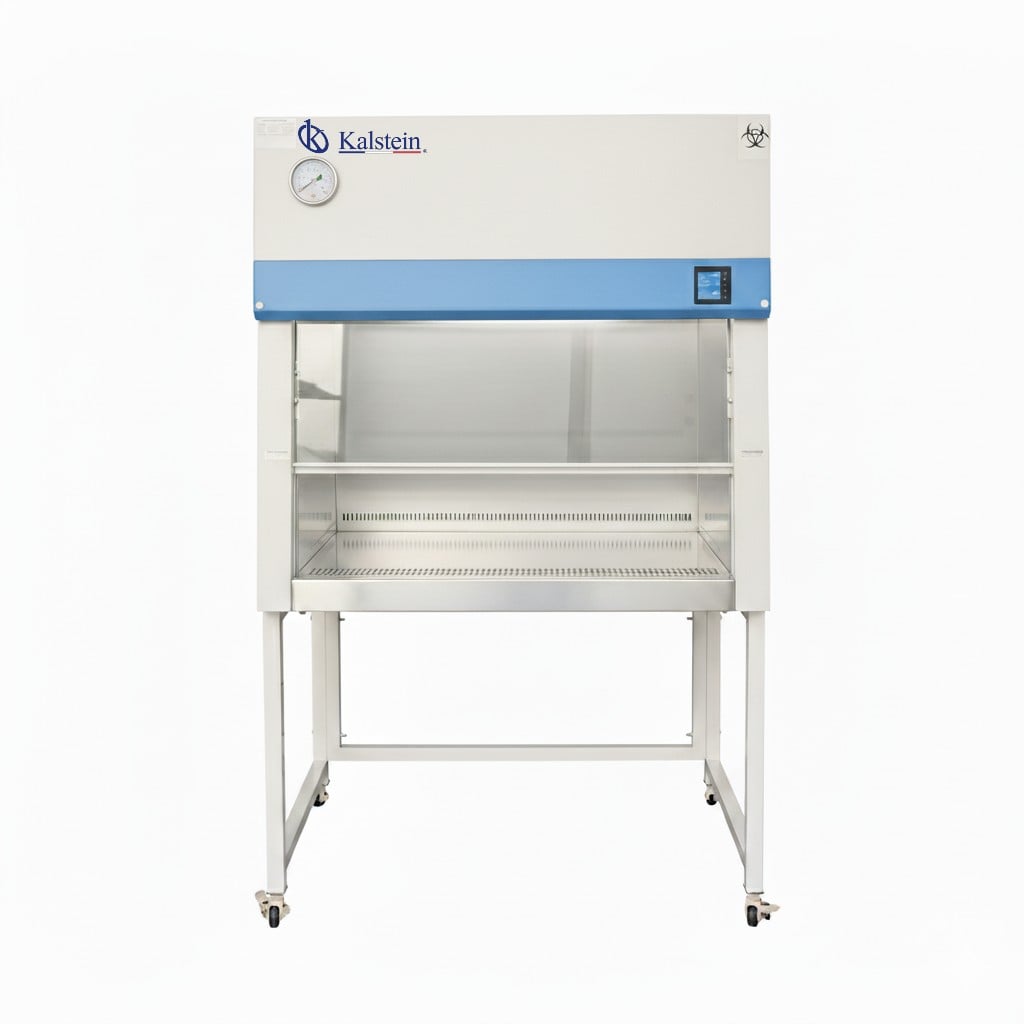
Biosafety Cabin YR06546: An Essential Tool for Quality Control
Product Description
The Biosafety Cabin model YR06546 is a state-of-the-art solution designed to ensure the protection of personnel, products, and the environment. This cabin operates on a negative pressure system that effectively prevents leaks, maintaining a safe work environment. The internal recirculation rate is 70%, while 30% is expelled externally, allowing for efficient airflow management.
The YR06546 is constructed from high-quality cold-rolled steel, providing a durable framework that resists wear and tear. The work surface is composed of corrosion-resistant physical-chemical plates, ensuring longevity even in demanding conditions. Precision CNC laser cutting and electrostatic epoxy resin treatment contribute to the overall durability and operational reliability of the cabin.
An intelligent control system integrates a user-friendly LCD touchscreen, making it easy to monitor and adjust operational statuses. The cabin complies with international standards, specifically ISO 14644.1 Class 5, equivalent to the U.S. Federal Standard 209E Class 100.
The YR06546 uses a high-efficiency EBM motor that delivers a strong air flow while minimizing energy consumption. This motor is optimized to reduce turbulence and ensure uniform air distribution. The cabin is equipped with external HEPA filters and highly efficient ULPA filters to maintain stringent cleanliness standards.
Market Price
The price of the YR06546 Biosafety Cabin is set at $2670.00 USD. This price reflects the high-quality materials and advanced technology integrated into the unit, making it a worthwhile investment for laboratories prioritizing safety and efficiency.
| Specification | YR06546 | YR06547 |
|---|---|---|
| External Size (mm) | 1500 x 760 x 2250 | 1800 x 760 x 2250 |
| Internal Size (mm) | 1340 x 600 x 600 | 1640 x 600 x 600 |
| Weight (kg) | 198 | 230 |
| Power Supply | 220V / 50Hz | 220V / 50Hz |
| Filtration Efficiency | 99.999% with ULPA | 99.995% with HEPA |
Frequently Asked Questions
What is the difference between ULPA and HEPA filters?
The ULPA series uses ultra-high-efficiency filters with an efficiency of 99.999%, while the HEPA series achieves high efficiency at 99.995%. Both are excellent, but ULPA provides a slightly higher level of purity.
What is the accuracy of the downward airflow control?
The downward airflow control accuracy is 0.015 m/s, ensuring uniformity and stability of the airflow to maintain sterility in the working area.
What sizes are available?
The YR06546 is available in a size of 1500 x 760 x 2250 mm externally and 1340 x 600 x 600 mm internally. Additional sizes are offered in the YR06547 model.
What level of cleanliness does the cabin guarantee?
The cabin guarantees Level 5 according to international standard ISO 14644.1, which is equivalent to Class 100 in the U.S. Federal Standard 209E, a strict requirement for sensitive environments.
What maintenance is required for optimal operation?
Regular maintenance on filters is essential, and users should frequently check the calibration of the imported sensor. Ensure the working environment meets temperature and humidity requirements.
Is the Biosafety Cabin mobile?
Yes, the cabin is equipped with sturdy wheels for easy mobility, though care must be taken to ensure stability during use.
How does the cabin help in laboratory environments?
The YR06546 Biosafety Cabin is crucial for handling low to moderate-risk biological agents, including viruses, bacteria, and cell cultures, making it an industry standard in microbiology labs, hospitals, and biopharmaceutical research centers.
Pros and Cons
Pros:
- Double Filtration: Utilizes external HEPA filters and ULPA/HEPA downward filters, achieving up to 99.999% efficiency.
- Superior Safety (Negative Pressure): The negative pressure design prevents leaks, protecting operators and the environment.
- Optimized Design: Reasonable airflow duct and optimized negative pressure box for airflow uniformity.
- High-Performance German Motor: Uses a low-energy, high-volume EBM motor.
- Durable Construction: Made of corrosion-resistant cold-rolled steel and epoxy resin surface treatment.
Cons:
- Environmental Requirements: The working environment must be maintained between 10 and 30°C with relative humidity below 70%.
- Shipping Weight: The shipping weight ranges from 138 kg to 198 kg, complicating transportation and installation.
- Flow Limitations: While it is a recirculation system (70% internal), the 30% external exhaust requires a venting system.
Field Usage
The Class II Type A2 Biosafety Cabin is indispensable for managing low to moderate-risk biological agents such as viruses, bacteria, and cell cultures that require biosafety. It is the standard choice in microbiology laboratories, hospitals, and biotechnology and pharmaceutical research centers where product, personnel, and environmental protection is essential. Its vibration control capability (mean wave: 3 μm) and stable airflow are crucial for sensitive experiments.
Recommendations
To ensure longevity and maximum safety:
- Perform regular maintenance on filters and check the calibration of the imported sensor.
- Validate that the working environment meets temperature (10-30 °C) and humidity (below 70%) requirements.
- Periodically review the inlet airflow speed (average of 0.53 m/s to 0.56 m/s) and the downward airflow speed (average of 0.35 m/s) to ensure effective negative pressure protection.
- Utilize heavy-duty wheels for initial positioning and ensure stability before use.
For further information or to request a quote on our products, please reach out to us directly.
If you are looking for a fusion of innovation and quality, you have come to the right place. At Kalstein, we offer you the luxury of exploring our exclusive catalog of laboratory equipment. We manufacture every device to the highest standards of excellence. Our intuitive and seamless online purchasing channels are designed for your convenience, securing the most competitive prices. Hesitate no longer — we bring science to life, it is time to become part of our community.